
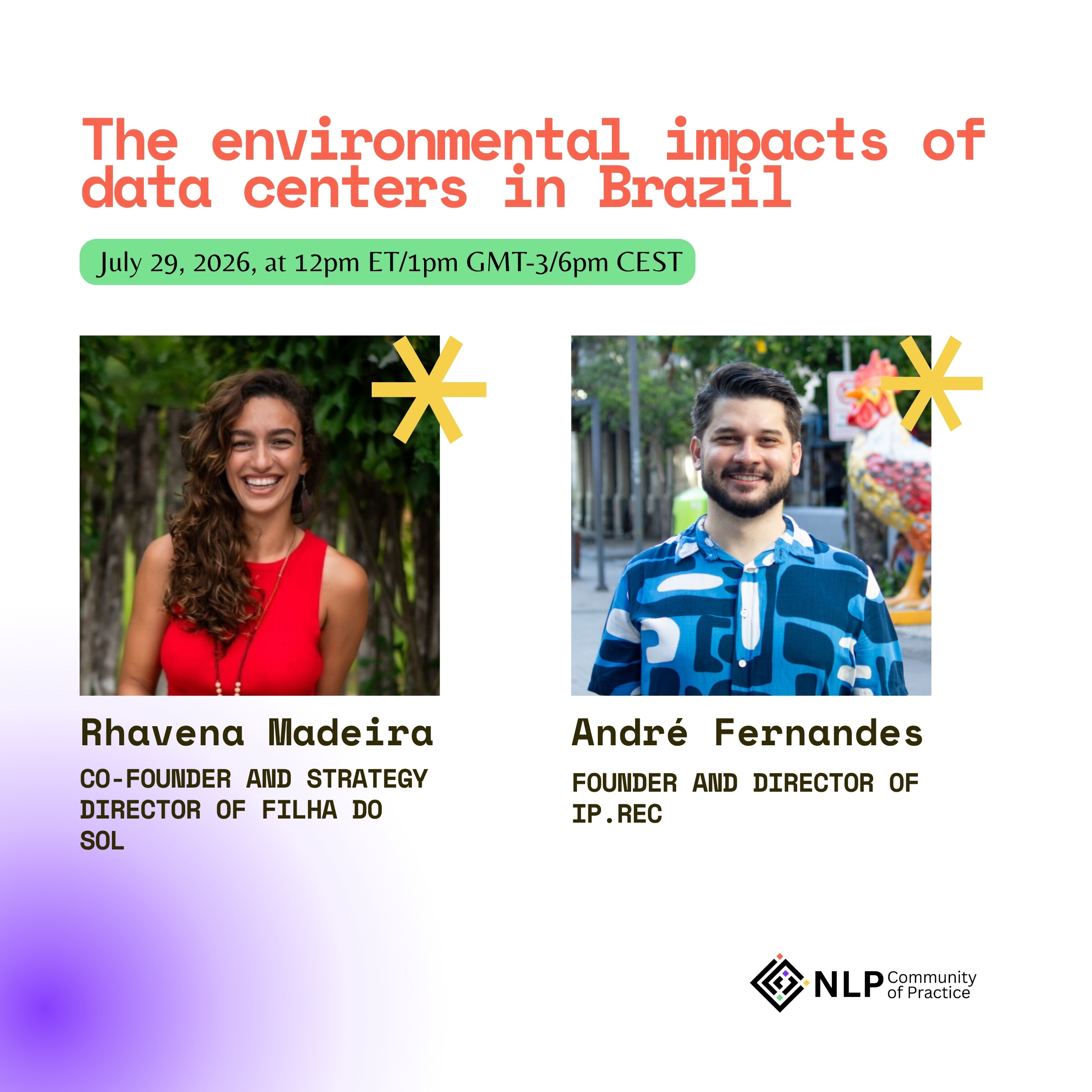
July 29: Learning about the environmental impacts of data centers in Brazil with Rhavena Madeira and André Fernandes
Data center proposals worth $64 billion have been blocked or delayed by strident civil society organizing across the United States in 2026. But the AI infrastructure boom is showing no signs of slowing down. So if not in the US, where are Big Tech companies taking this vital piece of the AI supply chain? Northeast Brazil has emerged as one lucrative data center construction hotspot. Attractive tax and utility subsidies aside, the region is also a wind and solar energy hub, allowing companies to effectively greenwash their data centers’ socio-environmental impacts. So what does the fight against data center expansion in northeast Brazil look like?
As part of their work in our community of practice, Madhuri Karak and Cathy Richards are co-leading a series of events exploring the global socio-environmental impact of data centers. The first edition of the series took place in spring 2026, focusing on the environmental impacts of data centers in the US and the European Union, intending to unpack the development of sustainability metrics within the industry.
To continue our event series focusing on the environmental impacts of data centers, how they are being regulated and what possibilities exist for resistance, we are inviting Rhavena Madeira (of Filha do Sol, in Piauí, Brazil) and André Fernandes (of IP.rec, in Pernambuco, Brazil) for a virtual roundtable taking place on July 29, 2026, at 12pm ET/1pm GMT-3/6pm CEST.
In Brazil, the federal government has been investing in data center expansion, all the while offering little evidence of what the country and its citizens stand to gain from this effort to lure investors. Though the antidemocratic practices of Big Tech companies pushing for data center expansion and the environmental impacts of these large, resource-intensive infrastructures have been pointed out by several civil society organizations, Brazil already has more than 160 data centers and is expected to receive billions in new investments in the sector.
We are honoured to be joined by Rhavena Madeira, director at Filha do Sol; and André Fernandes, director at IP.rec, for a conversation about their work against data center expansion in northeast Brazil. Filha do Sol is an organization working in Piauí to uplift feminist and collaborative leadership on the frontlines to regenerate tropical nature and restore climate justice; while IP.rec is an independent center engaged with a focus on the social, ethical, and legal impacts of technological development. IP.rec has recently published this report about AI and the environmental impacts of data centers, as well as this paper on the lack of clarity and opacity that often surrounds conversations about the environment and artificial intelligence.
About the speakers:

Rhavena Madeira (she/her) is Co-founder and Strategy Director of Filha do Sol. She is a Brazilian lawyer and project manager with a master’s degree in Human Rights (University of Vienna). For the past ten years, Rhavena has been working to defend socio-environmental rights and a stable climate with the government and civil society. In addition to Filha do Sol, she is also the director of the Center for Climate Crime Analysis Brazil. Rhavena has accumulated experience in managing complex projects and building alliances to defend human rights and climate justice, traditional communities, and local and regional organizations that live and defend their communities in threatened ecosystems, especially in the Amazon and the Brazilian Northeast.

André Fernandes (he/him) is Founder and Director of IP.rec. André is an Attorney and Professor in Graduate Programs in Law and Technology at UFPE, UPE, and CESAR School. He holds a PhD in Law, with a focus on Artificial Intelligence, the History of Legal Concepts, and Innovation, and a Master of Laws from the Federal University of Pernambuco, with a focus on Legal Theory. He specialized in Artificial Intelligence at the Amsterdam Law and Technology Institute (ALTI) & Vrije University Amsterdam, in AI Policy from the Center for AI and Digital Policy (CAIDP), and is certified in Internet Governance by the Brazilian Internet Steering Committee (CGI.br), DiGI (UCU) and SSIG.